
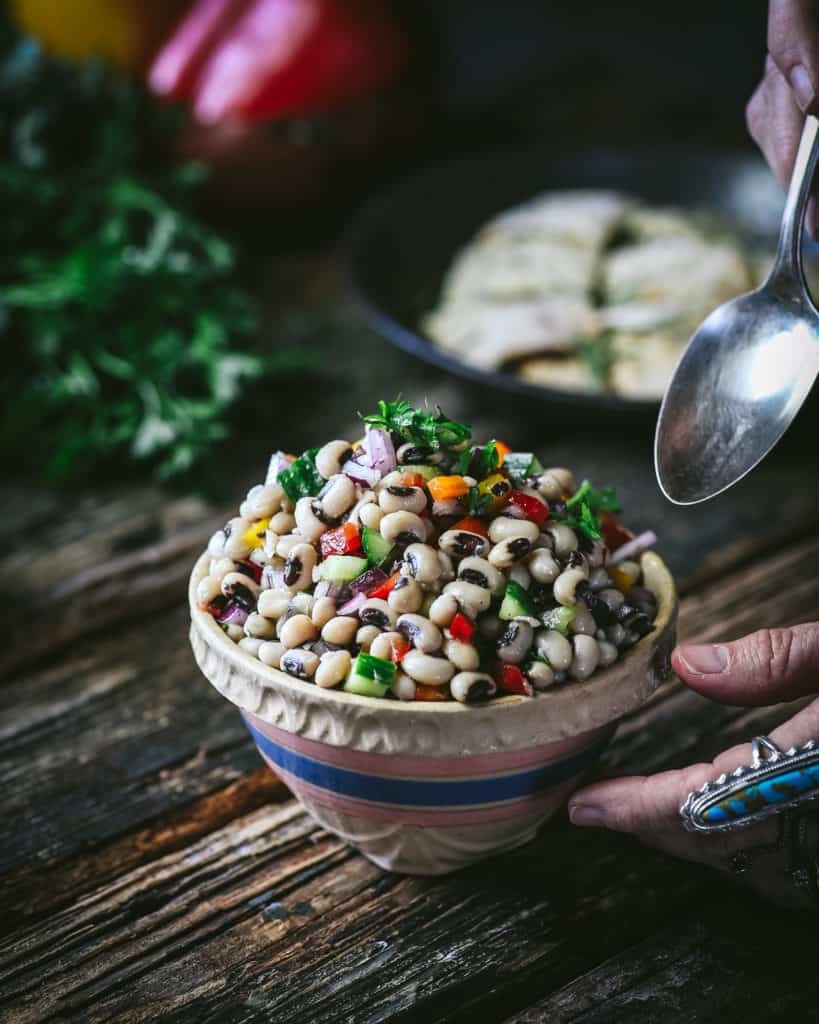
Southerners believe that eating black-eyed peas brings good luck in the New Year, so I try to make Black Eyed Pea Salad every January 1. A fresh interpretation of an old tradition, this has become a favorite side dish on our holiday table.
Black Eyed Pea Salad for Good Luck
Some varieties of black-eyed peas are called “cowpeas” and yes, food history tells us black-eyed peas were cultivated as animal fodder. The foodways of enslaved people included many ingredients that were deemed unsuitable for colonial tables. Black-eyed peas were imported from Africa as a crop that grew easily in different climates. Thus, the black eyed peas became incredibly common food for enslaved families.
In her book Cross Creek Cookery Marjorie Kinnan Rawlings said that “…(cowpeas) are served, with apologies, on city tables, without apology on country tables, and greeted with gusto at both.” If she wrote that apology, I wonder what she would say?
Rawlings is one of my favorite Southern writers as she often uses food as a way to describe the settings and characters in her stories. For me, Rawlings writing bears witness to the culture of race, food and economic disparity in the U.S. …sometimes difficult to read, but always worthy of remembrance, meditation and prayer.
For me, serving black-eyed peas is a moment of remembrance, like a culinary “Auld Lang Syne:” Remembering the past while looking forward to a better future.
Best Wishes in the New Year!
On this New Year’s Day as I post this recipe, I am sending along my best wishes for you as we turn a page of the calendar. Maybe a dish of Black Eyed Pea Salad seems trivial in light of everything our planet has endured in the last 365 days. Nonetheless, we have to restart and rebuild with small intentions. Serving up rembrance and luck are as good a place to start.

Leave a Reply